
Stadium General : Ramsar Convention as a Pillar of Wetland Conservation
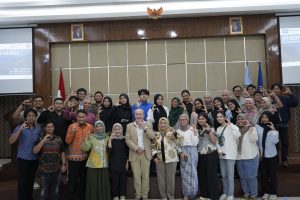
The Cluster for Paleolimnology (CPalim) invited Prof. Peter Gell PhD, a professor at Federation University Australia, to a stadium generale (expert lecture) discussing the natural conservation of Ramsar Sites on Tuesday, 10/09/2024. General Stadium with the topic of the Ramsar Convention at the Department of Biology, FSM Undip, which was attended by more than 200 undergraduate and postgraduate students of Biology. The rest invited the Founder of CPalim, Prof. Dr. Tri Retnaningsih Soeprobowati, CPalim ethnobotany expert Dr. Jumari, and CPalim taxonomy expert Dr. Lilih Khotimperwati. This program is a series of visits by foreign professors to support the internationalization policy of the UNDIP Campus. “Prof. Peter Gell’s presence in Indonesia is as an adjunct professor with full support from the World Class University (WCU) Program of UNDIP,” said CPalim Founder, Prof. Dr. Tri Retnaningsih Soeprobowati at the Acintya Prasada Building, Faculty of Science and Mathematics (FSM), Tembalang Campus.

Peter Gell discussed efforts to protect Ramsar Sites in the world during his visit this time. Ramsar is not an acronym, but comes from the name of the city of Ramsar in Iran, which is the location of an international agreement aimed at preserving and wisely using wetlands throughout the world. The Ramsar Convention was drafted by 18 participating countries at the meeting in Ramsar, Iran on February 2, 1971. Now there are 160 member countries (Parties) including Indonesia which has ratified the Ramsar Convention in 1991 through Presidential Decree No. 48 of 1991. Members (Parties) hold meetings every 3 years.
Currently, from 160 parties to the Ramsar Convention, 1,966 Ramsar Sites have been designated with an area of 190,726,803 ha worldwide. The purpose of the Ramsar Site designation is to protect wetland areas worldwide because they have high ecological value. India has at least 85 Ramsar Sites with the largest volume in South Asia. Ramsar Sites then became the term for various areas designated to protect the sustainability and function of wetlands in the world. The first site in the world was the Cobourg Peninsula in Australia which was designated in 1974. The largest site is Rio Negro in Brazil (120,000 square kilometers). In addition, there are Ngiri-Tumba-Maindombe in the Democratic Republic of Congo and Queen Maud Bay in Canada. Each of these sites covers an area of more than 60,000 square kilometers.
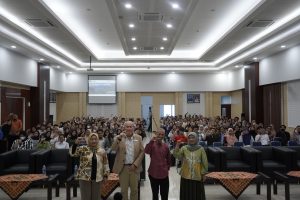
The Indonesian region also has sites like this. For example, Berbak National Park (Jambi), Sembilang National Park (South Sumatra), Rawa Aopa Watumohae (Southeast Sulawesi), and Danau Sentarum National Park (West Kalimantan). Then there is Wasur National Park (Papua), Pulau Rambut Wildlife Reserve National Park (Jakarta), Tanjung Puting National Park (Central Kalimantan), to Menipo Nature Tourism Park (Timor). Peter Gell, who also spent about two weeks in Indonesia, carried out various academic agendas. Starting from public lectures at FSM and the Postraduate School (SPS) to preparing collaborative scientific publications. In addition, he became a clinical mentor for student manuscripts, field studies, and workshops on sustainable mineral water resource management.
News about this activity can also be read at this link.
-HH-

Leave a Reply