
Developing Madura’s Mangrove Ecosystem as an Ecotourism Hub: A Sustainable Solution for Climate Change Mitigation
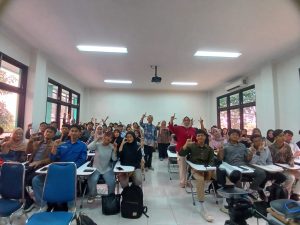
Mangroves serve as natural coastal barriers, carbon sinks, and promising ecotourism destinations. Recognizing this potential, the Marine Science Program at Trunojoyo University of Madura (UTM) organized a webinar on “Developing Madura’s Mangrove Ecosystem as Ecotourism” on February 24, 2025. The hybrid event gathered UTM Marine Science students on-site and online participants from various government agencies and universities.
Prof. Dr. Tri Retnaningsih Soeprobowati, founderof CPalim UNDIP, opened the session with a discussion on Paleolimnology Approaches for Mangrove Ecosystem Studies. Paleolimnology reconstructs past environmental events through sediment analysis, which helps track historical sea-level changes and coastal dynamics, as observed in Semarang.
Following this, Dr. Jumari, S.Si., M.Si (UNDIP) highlighted the role of riparian mangrove vegetation as a green buffer against coastal erosion. He emphasized that riparian mangroves absorb more carbon than monoculture agricultural land, making them crucial for climate resilience. However, mangrove forests in Madura face challenges from reclamation activities and plastic waste pollution, threatening biodiversity and eco system stability.
Dr. Lilih Khotim Perwati, S.Si., M.Si (UNDIP) then discussed mangroves as bioindicators of air quality using the Air Pollution Tolerance Index (APTI). This index classifies plants based on their ability to withstand pollution. Sensitive mangrove species can serve as pollution indicators, while tolerant species aid in land rehabilitation. Research in Surabaya identified Rhizophora mucronata as the best bioindicator among true mangroves and Terminalia catappa as an ideal associate species for monitoring air quality.
The final session, led by Insafitri, S.T., M.Sc., Ph.D (UTM), focused on mangrove ecotourism potential in North Bangkalan. With 17 mangrove species and densities ranging from 400 to 2,500 trees per hectare, the region boasts rich biodiversity. Site suitability for ecotourism was assessed through transect methods, evaluating factors such as mangrove density, biota diversity, tides, accessibility, and infrastructure. Ecotourism development in Bangkalan is expected to drive environmental conservation and economic benefits for local communities. Insafitri emphasized the need for stronger promotion and sustainable management to enhance the region’s tourism appeal.
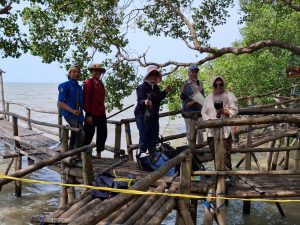
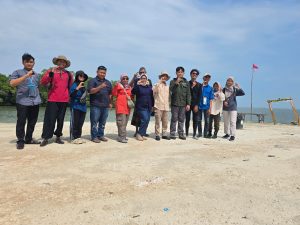
In addition to the webinar, a field study was conducted from February 21–23, 2025, in collaboration with UTM students and faculty. Researchers collected mangrove samples, measured vegetation density, assessed water and soil quality, and analyzed sediment composition across multiple sites, including Mertajasah, Arosbaya, and Tajungan in Bangkalan, Madura. This collaborative effort aimed to provide scientific data supporting conservation and ecotourism strategies, ensuring Madura’s mangrove ecosystems remain a sustainable model for climate resilience and community-based tourism.
-HH-

Leave a Reply